
 Highstreetpharma.net is the ONLY Official Website. Best Price Guaranteed. Don’t trust communications from..
 Bookmark






REVIEWS ON GOOGLE, REDDIT, TECHMOREREVIEW.COM: EXCELLENT



Methoxsalen Oxsoralen (Oint)
Price range: $27.00 through $131.40
Oxsoralen is a prescribed drug and it is used to treat the signs and symptoms of vitiligo, psoriasis, and cutaneous T-cell lymphoma. It is possible to use Oxsoralen-Ultra by itself or in combination with other drugs.
REVIEWS ON GOOGLE, REDDIT, TECHMOREREVIEW.COM: EXCELLENT

Introduction
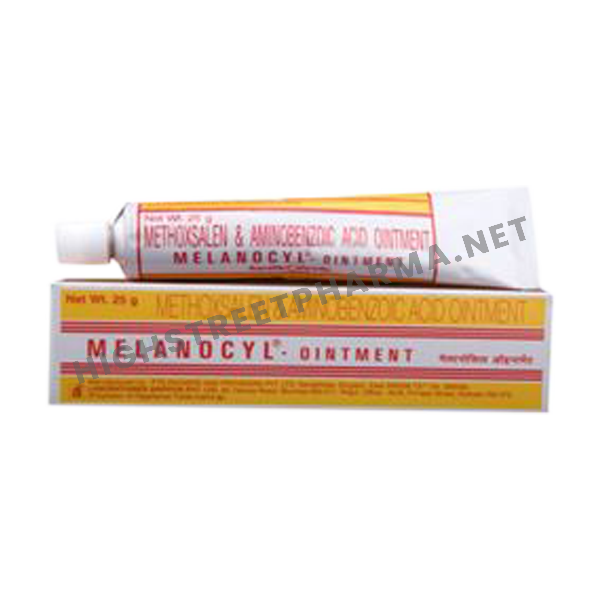
Melanocyl Ointment is a topical skin formulation containing two active ingredients, Methoxsalen and Aminobenzoic Acid. It is primarily associated with the management of vitiligo, a skin condition characterised by the development of lighter patches due to the loss or reduction of melanin pigment. The formulation combines the properties of a photosensitising compound and an ingredient associated with ultraviolet protection.
Skin pigmentation is influenced by specialised cells called melanocytes, which produce melanin. This pigment gives skin its natural colour and helps protect it against ultraviolet radiation. Changes in melanocyte activity or their loss can result in uneven pigmentation. Understanding the ingredients in Melanocyl Ointment helps explain its role in pigmentation-related skincare and its relationship with controlled light-based treatment.
What Is Melanocyl Ointment?
Melanocyl Ointment is a topical formulation containing Methoxsalen 0.75% w/w and Aminobenzoic Acid 2% w/w. These ingredients have different properties that contribute to the formulation’s intended role in managing pigmentation concerns.
Methoxsalen belongs to a group of compounds known as psoralens. It is a photosensitising substance that interacts with ultraviolet A (UVA) radiation and influences biological processes within skin cells. This property makes it relevant to photochemotherapy, a treatment approach involving a combination of a photosensitising substance and controlled ultraviolet exposure.
Aminobenzoic Acid, also known as para-aminobenzoic acid (PABA), is an organic compound historically associated with ultraviolet light absorption, particularly in sunscreen formulations.
The combination makes this ointment different from ordinary moisturising or cosmetic skin products. Its formulation is associated with pigmentation management rather than simply improving surface hydration.
Key Ingredients and Their Properties
- Methoxsalen 0.75% w/w
Methoxsalen is the principal photosensitising ingredient in the formulation. It belongs to the psoralen family and has the ability to interact with UVA radiation.
When activated by suitable ultraviolet light, methoxsalen can interact with cellular DNA and influence the activity of skin cells. In controlled phototherapy, these interactions can contribute to biological changes associated with pigmentation.
In vitiligo management, this photosensitising property is relevant because controlled light exposure can stimulate melanocyte activity and support repigmentation in selected areas.
- Aminobenzoic Acid 2% w/w
Aminobenzoic Acid is another important component. It is an aromatic organic compound historically used in topical sunscreen preparations because of its ability to absorb certain ultraviolet wavelengths.
Its presence distinguishes the combination from formulations containing methoxsalen alone. The two ingredients have different chemical properties and should not be considered interchangeable.
The exact contribution of Aminobenzoic Acid to the finished ointment depends on the formulation and its intended application.
How Does Melanocyl Ointment Work?
The working mechanism of Melanocyl Ointment is primarily connected with the photosensitising action of methoxsalen.
Vitiligo involves the loss or reduced function of melanocytes, the specialised cells responsible for producing melanin. Without sufficient melanin production, certain areas of skin become lighter than the surrounding complexion.
Methoxsalen increases the sensitivity of treated skin to UVA radiation. In controlled phototherapy, the interaction between the ingredient and ultraviolet light can influence cellular activity and support repigmentation processes.
The treatment approach involves several biological processes:
- Photosensitisation: Methoxsalen makes the treated skin more responsive to UVA radiation.
- Cellular interaction: Activated methoxsalen interacts with cellular components, including DNA.
- Pigmentation activity: Controlled phototherapy can stimulate processes associated with melanocyte function and pigment formation.
- Gradual repigmentation: Changes in pigmentation may develop progressively rather than immediately.
These processes explain why methoxsalen is associated with phototherapy rather than ordinary topical skin hydration.
Potential Benefits and Skin-Related Applications
Melanocyl Ointment is primarily associated with vitiligo-related pigmentation concerns. Its active ingredients have properties that make the formulation relevant to specific dermatological applications.
Some important aspects include:
- Supports Vitiligo Management
Vitiligo causes patches of skin to lose their natural pigmentation. Methoxsalen is used in phototherapy approaches that aim to encourage repigmentation in affected areas. Its photosensitising properties are central to this application.
- Influences Melanin Production
Melanin is responsible for the natural colour of skin, hair and eyes. Through its role in controlled phototherapy, methoxsalen can support biological processes associated with the restoration of pigment in selected skin areas.
- Works Through a Photosensitising Mechanism
Unlike conventional cosmetic ingredients, methoxsalen works by changing the skin’s response to ultraviolet radiation. This characteristic makes it particularly relevant to light-based dermatological treatment.
- Combines Two Distinct Ingredients
The inclusion of Aminobenzoic Acid alongside methoxsalen provides a combination of ingredients with different ultraviolet-related properties. Their individual characteristics contribute to the formulation’s overall composition.
It is important to understand that pigmentation changes are not guaranteed, and responses can vary depending on the affected area, skin characteristics and individual treatment response.
Understanding Vitiligo and Skin Pigmentation
Vitiligo is a condition in which melanocytes are destroyed or stop functioning properly in certain areas of the skin. As a result, melanin production decreases, creating white or lighter patches.
The condition can affect different parts of the body, including the face, hands, arms, legs and other areas. Its progression varies considerably. Some individuals experience small, localised patches, while others develop more widespread changes in pigmentation.
Melanocytes are located in the lower layer of the epidermis. They produce melanin and transfer pigment-containing structures to surrounding skin cells. This process helps maintain an even skin tone.
Phototherapy-based approaches aim to influence pigmentation activity through carefully controlled exposure to ultraviolet radiation. Methoxsalen is relevant to this approach because of its photosensitising properties.
Important Skin Care Considerations
Skin exposed to methoxsalen can become significantly more sensitive to ultraviolet radiation. This is one of the most important characteristics to understand when learning about the formulation.
Uncontrolled exposure to sunlight or artificial ultraviolet sources can cause excessive redness, irritation and potentially serious skin burns.
Some important considerations include:
- Protect treated skin from unexpected sunlight and excessive ultraviolet exposure.
- Avoid unnecessary sunbathing and tanning activities.
- Use appropriate protective clothing and sun protection.
- Do not assume that ordinary daylight is harmless after methoxsalen exposure.
- Keep the formulation away from the eyes and other sensitive areas.
- Monitor the treated skin for unusual redness, swelling or blistering.
Phototherapy involving methoxsalen requires careful control of ultraviolet exposure. The product should not be treated as an ordinary sunscreen or everyday pigmentation cream.
Possible Side Effects
Like other photosensitising topical formulations, Melanocyl Ointment may cause local skin reactions. The intensity of these effects can differ between individuals.
Possible reactions include:
- Skin redness or erythema.
- Itching and irritation.
- Burning sensations.
- Dryness or discomfort.
- Increased sensitivity to sunlight.
- Excessive redness or blistering following ultraviolet exposure.
Severe reactions should not be ignored. Persistent irritation, significant swelling or blistering requires appropriate medical assessment.
Storage and Product Handling
Correct storage helps preserve the quality of topical ointments. Melanocyl Ointment should be kept in its original packaging and stored according to the instructions provided on its label.
Avoid excessive heat, direct sunlight and unnecessary exposure to moisture. Keep the container tightly closed when not in use and away from children’s reach.
Checking the product’s expiry date and inspecting its packaging are also useful precautions. The ingredients and concentrations should be verified on the actual product label because formulations and packaging information can vary.
Conclusion
Melanocyl Ointment is a specialised topical formulation containing Methoxsalen 0.75% w/w and Aminobenzoic Acid 2% w/w. Its primary association is with vitiligo and pigmentation-related dermatological treatment. Methoxsalen acts as a photosensitising compound that interacts with UVA radiation, making it relevant to controlled phototherapy and processes associated with repigmentation. Aminobenzoic Acid contributes a different set of ultraviolet-related chemical properties.
Understanding the formulation requires recognising that it is not an ordinary moisturiser or cosmetic skin-brightening product. Its effects are connected with specific biological responses to ultraviolet light. Appropriate skin protection, awareness of photosensitivity and careful attention to possible reactions are important considerations. Overall, its ingredient combination makes it a specialised formulation within the field of pigmentation management.
Content Source: View Source PDF
Additional information
| Doses | 25 mg |
|---|---|
| Quantity | 1 Qty, 3 Qty, 6 Qty |




davispadro –
100% satisfied